

The King Chronicles: Breaking Chains
- Dec 10, 2025
- 7 min read
Stephen King explores the resiliency of women and their ability to overcome unhealthy domestic situations in what he’s reductively and unofficially named “The Abused Women Trilogy.” Though this isn’t actually a trilogy in the conventional sense as the characters do not truly interact (with a minor exception to Dolores and Jessie), they all pull from the same themes. We follow three different women in isolating abusive relationships and their arcs to freedom and healing. King notoriously objectifies women through the eyes of his male characters in his books (whether that objectification comes from the author’s views or his characters’ is a whole other rabbit hole we could go down), but he also writes some incredibly strong women. We get our first real dose of the strength he can write into female characters with Beverly Marsh from It and Bobbi at the beginning of The Tommyknockers. There are arguably other instances of particularly strong women like in Carrie, but Bev and Bobbi felt like prototypes for the trio of women to come in the novels I’m visiting today.
There’s a great thesis discussing some of King’s characters in relation to feminism by Jennifer (Lee) Smith. Though he certainly has not been consistent in giving all of his female characters depth–I’m looking at you, Wendy Torrance–neither has he always given male characters depth. King often leans on archetype characters for his villains or side characters as plot drivers. When he is striving to create a complex character, King writes resourceful, strong, and quick-minded heroes and heroines. Unfortunately, more often than not, his main characters are male leaving their female counterparts to receive the aforementioned side-character treatment.
You should always check for content warnings that apply to you before stepping into any Stephen King book, but as these sensitive topics are major themes that will be discussed below, I’m also going to put some warnings for my post here: sexual abuse, abuse, violence, pedophilia, marital rape, death. These do not cover all of the warnings you may need to see before reading the books, so please do your research if you need them.
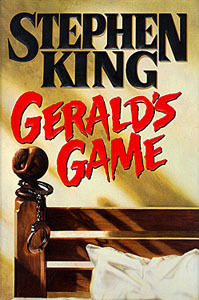
Gerald’s Game (1992) | 3 Stars
Jessie and Gerald Burlingame escape to their remote lake house for a spontaneous romantic getaway. When her husband handcuffs Jessie to the bed as part of a kink game, it unlocks some powerfully traumatic memories from Jessie’s childhood that has her fighting tooth and nail to escape her bondage. A hard kick sends Gerald to a coronary death on the dusty floor. Jessie is handcuffed to a bedpost with no one to hear her scream but the voices of repressed memories in her head.
At first I thought King was going to be daring by writing an entire book set in a single room. He’s incredibly talented at building suspense through character discomfort, so I do not think it would be a stretch of his abilities. We do experience Jessie’s mounting panic from being physically trapped to the bed, but the setting finds variation from Jessie’s childhood memories of trauma that took place as she and her father watched a solar eclipse. This book is particularly gruesome I feel. There were some graphic scenes that had my guts roiling, and the difficult scenes were of such varying nature that no one is safe from at least some discomfort. King did a remarkable job with the horror elements in here.
The dual timelines worked well together to keep the reader engaged most of the time, but the threads felt somehow disconnected in places. Present day Jessie and her childhood equivalent sometimes had a personality disconnect, like they were two entirely different characters. I found this odd since King did a remarkable job writing both the young and grown up variations of the characters in It. King also used the solar eclipse in Jessie’s childhood to loosely tie Gerald’s Game to Dolores Claiborne, a book that would not be published for another year. With absolutely no knowledge of the old woman that appears in Jessie’s mind’s eye, Dolores' appearance just adds to the odd detachedness between the arcs. It is very common for a King book to reference characters or places from his other works, so I’m not sure why this particular instance didn’t work for me. As if the book wasn’t ambitious enough, King slips in some cheaply rendered references to The Raven in attempts of thematically pulling everything together in the last 50 or so pages of the book.
Overall, I enjoyed the premise and the horror was effective. The actual delivery of the plot was weak at points and hazy at others. It was an okay reading experience at the end of the day. Jessie didn’t have a growth and healing arc to the magnitude I was hoping for, but you cannot argue that she did not overcome her trauma.

Dolores Claiborne (1993) | 4 Stars
A pissed off woman gives a tell-all about her abusive marriage, cranky boss, and the murder of her husband by her own hand with the frankness and profanity only a tired old woman can muster. Dolores Claiborne is brought into custody and held on trial for the murder of her boss. She will prove herself innocent of the murder charge while telling the committee how she murdered her own husband during a solar eclipse years ago. (yes, the same one from Jessie Burlingame’s story.)
Dolores’ escape from her domestic cage was the most outwardly strong arc of the three. She manages to flip the power dynamic on her husband and reclaim her dignity. Nowadays, any themes of motherhood speak to me so much more than they did when I first read this book as a teenager, so the stakes felt higher in this book for both Dolores and her children. Dolores also struggles with a difficult power dynamic at work. She works to maintain a chance of fiscal freedom from her husband, but her boss is a domineering woman with a cantankerous attitude and a history of firing employees before ever learning their names.
This was actually the first King book I had ever read a decade ago. Though many major plot points were still clear in my mind, a reread was necessary for this project to clear up the details that had gone murky over the years. It was just as fast-paced as I remember it being. Dolores is a fantastic narrative voice. She has a remarkably witty sense of humor and no-nonsense attitude. She’s who I want to be when I grow up. A frame-story always works well for me as a reader. It allows the narrator to have a less formally omniscient voice, so Dolores’ personality bleeds out of the prose. The book has an incredibly potent personality, and it was really easy to get lost in. I enjoyed reading Dolores Claiborne. It just might be one of my favorite Stephen King books so far.

Rose Madder (1995) | 3 Stars
Rose Daniels fears for her life. Her husband, Norman, has abused her regularly since the night of their honeymoon. She awakens one morning and confronts a single spot of blood on her sheets left by her bloody nose the night before. She knows her options are limited; he will kill her if the sheets are not made spotless before his return home. Rose flees with only Norman’s ATM card and begins a long journey to healing and independence. Norman is a crooked cop with a keen knack for finding people who do not wish to be found. Rose Madder is a cat and mouse story of Norman’s descent into madness and Rose’s desperate fight for freedom.
Though strong and resilient, Rose isn’t exactly the smartest heroine out of these three books. Her lack of street smarts makes sense though, as her husband kept her isolated from society for their thirteen years of marriage. King illustrates emotional abuse as much as he does the physical kind in this book. Rose spent over a decade in fear of her husband. Even when he wasn’t actively attacking her, she feared stretches of silence or seemingly jovial moments for a sign of the inevitable switch flip. Rose’s horrific experiences feel the most raw and evocative out of the three heroines discussed today because they are the freshest experiences at the time of the narrator’s recollections. Jessie and Dolores are recalling incidents from their pasts while we follow Rose through her experience in real time. Rose’s growth arc is this book's strongest pillar.
Norman is a terrifying villain. He’s cunning, resourceful, and unsettlingly unhinged. King writes mad characters very well. Norman has never been mentally stable, but he becomes increasingly insane as the story progresses and adds some disturbing imagery throughout the book. In his memoir On Writing, King describes this book as a "stiff, trying-too-hard novel...", and though I may agree to some extent, Norman does bring a lot of tension to the story and breathes unsettling life into it.
Rose Madder becomes too ambitious in incorporating a an awkward fantastical element to the story. Rose finds a low-quality painting of a woman in a pawn shop and feels compelled to buy it. The painting seems to have some surreal properties and the woman in the painting shifts into a parallel entity (or “twinner,” if you’ve read The Talisman) to Rose. The painting becomes a secondary driving force for the plot, and eventually brings us to the clunky conclusion of the book. I know the fantastical elements are what keeps Rose Madder from becoming a cookie-cutter “woman escapes man tracking her” story, but it did more to turn this book into a Dark Tower installment than it helped to give the story a spine.
At the end of the day, I had a perfectly fine experience with Rose Madder. It was thrilling while I was buried in its pages, but it wasn’t anything particularly stand-out from King’s bibliography. I’m not sure the book will have much staying power in my mind apart from a few particularly gruesome scenes. I could see a couple characters or settings coming back to play in other King books like The Dark Tower, but I don’t think any of them will be particularly important roles.


Comments